
Disputes with neighbours — over boundaries, noise, anti-social behaviour, or harassment — are among the most stressful disputes ordinary people face, precisely because they involve someone you cannot avoid and whose conduct directly affects your home and your peace of mind. When informal resolution has failed, evidence becomes important, both for any formal complaint and for your own clarity about what is actually happening.
Types of Neighbour Disputes We Support
Noise nuisance: documenting a pattern of noise that exceeds what is reasonable, in a form that supports a complaint to the local authority’s environmental health team or, where necessary, legal action.
Anti-social behaviour: evidence gathering in relation to harassment, intimidation, or anti-social conduct by a neighbour, supporting both informal resolution attempts and, where necessary, applications for an injunction or reports to the police.
Boundary and property disputes: background research into property titles and boundaries where there is a dispute about land ownership or boundary location, which often needs to be combined with a chartered surveyor’s assessment.
CCTV and camera disputes: where a neighbour’s camera or CCTV system appears to be capturing footage of your property in a way that may breach UK GDPR, an assessment of the camera’s field of view and the proportionality of its positioning.
Harassment patterns: where a neighbour’s conduct amounts to a pattern that may constitute harassment under the Protection from Harassment Act 1997, documentation of that pattern over time.
Why Evidence Matters in Neighbour Disputes
Neighbour disputes are notoriously difficult for local authorities and courts to resolve when they come down to one person’s word against another’s. A contemporaneous, well-documented record of specific incidents — dates, times, descriptions, and where appropriate video or audio evidence — is far more persuasive than a general complaint that the relationship has deteriorated.
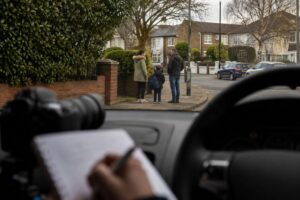
Professional involvement also adds objectivity. A diary kept by a professional investigator, or footage gathered by a trained operative observing from a lawful vantage point, carries more weight than the same observations made by an obviously interested party.
What We Can and Cannot Do
We can observe and document what occurs in public or publicly visible spaces — a garden visible from a public area, noise audible from outside the property, conduct occurring in shared or communal areas. We cannot and will not trespass on a neighbour’s property, install recording equipment on their property without consent, or intercept private communications.
Where the dispute involves genuine safety concerns or a pattern that may constitute a criminal offence, we will always recommend involving the police alongside any private evidence gathering.
Dealing with a difficult neighbour dispute and need evidence? Contact UKPI for a confidential consultation.